
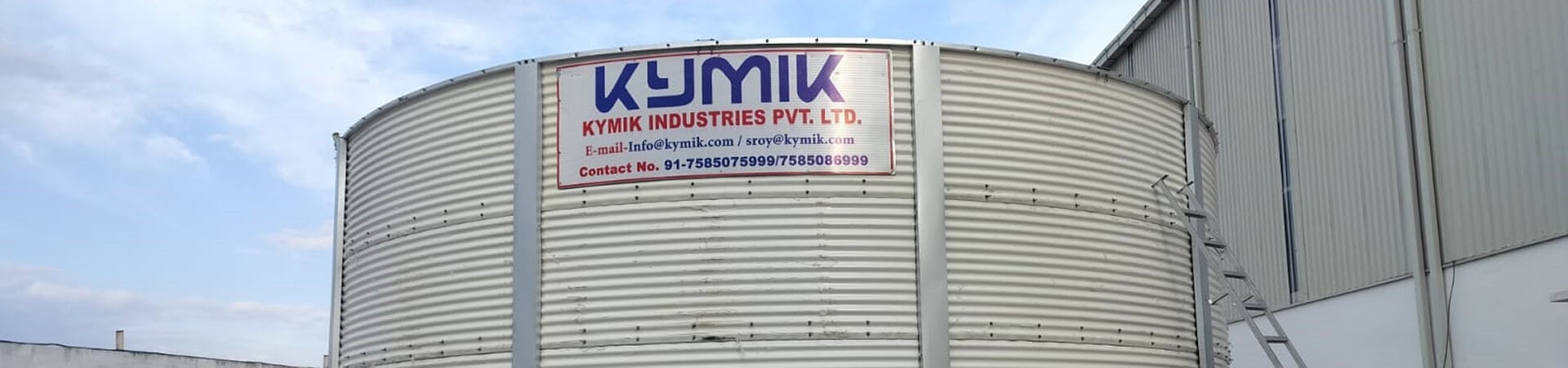

Zincalume STP Tanks: A Complete Guide to Sewage Treatment Plant Storage
Zincalume STP tanks provide modular steel storage solutions for sewage treatment plants in residential, commercial, and industrial facilities. These tanks use corrosion-resistant Zincalume steel panels to create strong and adaptable storage structures. With suitable protective liners and engineering, they can support different stages of wastewater treatment.
Modern sewage treatment plants require dependable storage systems to manage wastewater efficiently. Therefore, selecting the right tank material, capacity, and configuration is essential for long-term operation.
Kymik Industries Pvt. Ltd. manufactures customized Zincalume bolted-panel tanks for industrial and infrastructure applications. Our engineering team considers wastewater characteristics, structural requirements, and site conditions before recommending a suitable tank system.
This guide explains the construction, benefits, applications, installation requirements, and selection factors of Zincalume STP tanks.
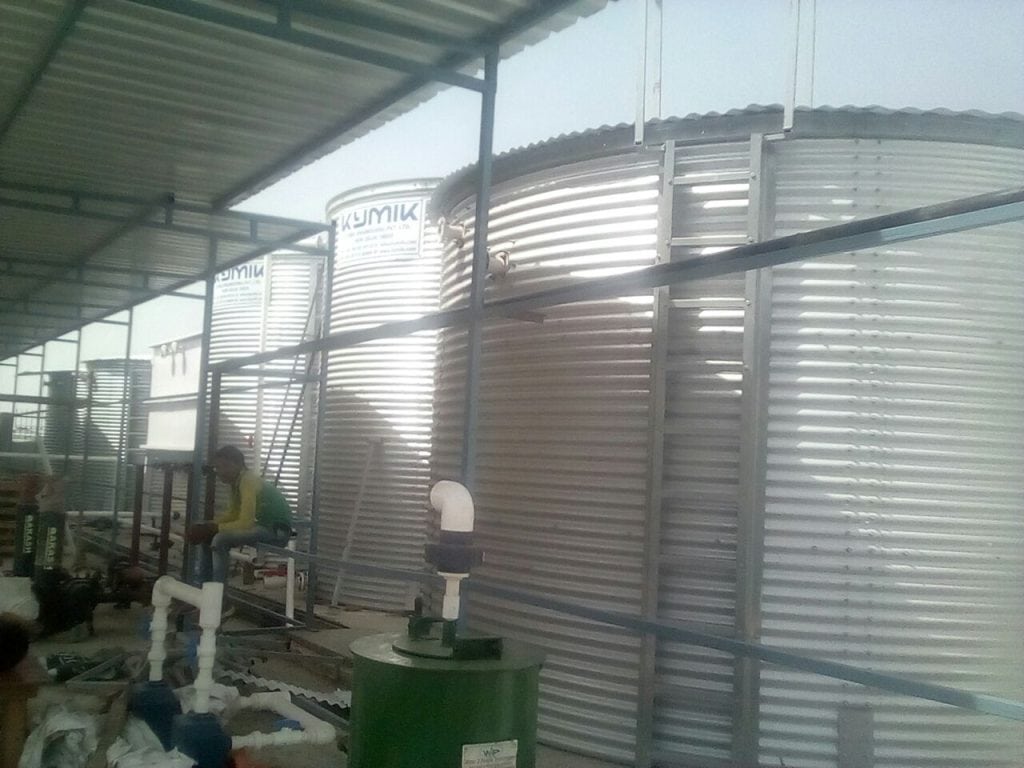
Table of Contents
What Are Zincalume STP Tanks?
Zincalume STP tanks are engineered steel tanks designed for suitable storage and treatment stages within sewage treatment plants. Manufacturers construct these tanks using modular Zincalume steel panels joined with bolted connections.
Zincalume steel typically contains a protective coating of approximately 55% aluminum, 43.5% zinc, and 1.5% silicon. This metallic coating provides resistance to atmospheric corrosion and helps protect the steel structure.
However, sewage contains contaminants, dissolved chemicals, and microorganisms that may affect tank materials. Therefore, Zincalume tanks intended for wastewater contact generally require a compatible internal liner or protective system.
The liner separates stored wastewater from the steel panels. Consequently, the tank combines the structural advantages of steel with a protective barrier selected for the wastewater application.
How Do Zincalume Tanks Work in Sewage Treatment Plants?
A sewage treatment plant processes wastewater through different physical, biological, and chemical treatment stages. Each stage may require tanks for collection, equalization, aeration, clarification, or treated water storage.
Zincalume tanks for sewage treatment plants can serve selected stages when the tank design and internal protection meet the process requirements.
For example, an equalization tank helps balance wastewater flow before further treatment. Meanwhile, a treated water tank stores processed water for reuse or discharge.
The steel tank provides structural containment, while the treatment equipment performs the actual sewage treatment. Therefore, the tank must be integrated with suitable pumps, aeration equipment, piping, and process controls.
Key Benefits of Zincalume STP Tanks
1. Strong and Durable Steel Construction
Zincalume steel offers structural strength for engineered storage systems. Its metallic coating also helps resist atmospheric corrosion.
Additionally, the bolted-panel construction creates a practical storage solution for different project capacities.
However, durability depends on the operating environment, protective liner, maintenance, and overall tank design.
2. Modular Bolted-Panel Design
One major advantage of Zincalume STP tanks is their modular construction.
Manufacturers fabricate individual steel panels before transporting them to the installation site. Installation teams then assemble the panels using engineered bolted connections and sealing components.
This method simplifies transportation and supports efficient installation. Moreover, it reduces the need to transport a fully assembled large-capacity tank.
3. Customized Storage Capacities
Every sewage treatment plant has different wastewater volumes and operating requirements.
Therefore, Kymik develops tank configurations according to the required capacity, diameter, height, and site conditions.
Customized designs also accommodate suitable inlet connections, outlet arrangements, access openings, and other project-specific components.
4. Suitable Internal Protection
Wastewater composition varies across residential, commercial, and industrial facilities.
For this reason, Zincalume sewage treatment tanks require careful evaluation of the intended stored media.
Depending on the application, engineers may specify compatible internal liners, sealing systems, and protective components. These measures help limit direct wastewater contact with the steel structure.
5. Maintenance and Inspection Accessibility
Modular tank systems can incorporate manholes, access ladders, inspection openings, and maintenance accessories.
These components help operators inspect tank interiors, monitor fittings, and perform necessary maintenance.
Furthermore, regular inspection supports early identification of liner damage, seal deterioration, or structural concerns.
6. Recyclable Steel Construction
Steel is widely recyclable, making it a useful material for engineered infrastructure.
The modular construction of Zincalume STP tanks also supports efficient material transportation and assembly.
However, environmental performance depends on the complete tank system, manufacturing process, service life, and end-of-life handling.
Applications of Zincalume Tanks in Sewage Treatment Plants
Zincalume tanks for sewage treatment plants can support different storage functions. However, each application requires suitable engineering and wastewater compatibility assessment.
1. Sewage Collection Tanks
Collection tanks receive wastewater from residential, commercial, or industrial drainage networks.
They provide temporary storage before wastewater enters the treatment process.
2. Equalization Tanks
Equalization tanks help balance variations in wastewater flow and concentration.
Consequently, downstream treatment equipment receives a more consistent wastewater supply.
3. Aeration Tanks
Aeration tanks support biological treatment processes by providing an environment for microorganisms to break down organic pollutants.
When specified for this application, the tank must accommodate aeration equipment, process loads, and appropriate internal protection.
4. Clarification and Process Tanks
Certain treatment systems require tanks for settling, separation, or intermediate storage.
The suitability of a bolted steel tank depends on the selected process, structural design, and equipment requirements.
5. Treated Water Storage Tanks
After treatment, facilities may store processed water for reuse in flushing, gardening, cooling, or other permitted applications.
Suitable STP water tanks help maintain the required storage capacity before reuse or discharge.
Industries That Use Zincalume STP Tanks
1. Residential Developments
Apartment complexes, housing societies, and residential townships require sewage treatment facilities to manage domestic wastewater.
Zincalume tanks can support suitable treatment and storage stages where the design meets project requirements.
2. Commercial Buildings
Hotels, shopping complexes, office buildings, hospitals, and educational institutions generate wastewater through daily operations.
These facilities may require customized sewage treatment plant tanks to accommodate changing wastewater volumes.
3. Industrial Facilities
Factories and industrial estates require wastewater management systems according to their operational activities.
However, industrial effluent may contain aggressive chemicals or unusual contaminants. Therefore, engineers must confirm material and liner compatibility before selecting a Zincalume tank.
4. Institutional and Infrastructure Projects
Airports, transport facilities, educational campuses, and other infrastructure projects may require centralized wastewater treatment systems.
Modular steel tanks offer flexible storage configurations for suitable applications.
Installation Requirements for Zincalume STP Tanks
Proper installation plays an important role in the performance of bolted steel STP tanks.
i. Foundation Preparation
The tank requires a foundation designed for its operating weight, ground conditions, and structural loads.
Engineers must also consider settlement, wind, seismic conditions, and applicable site requirements.
ii. Panel Assembly
Installation teams assemble prefabricated panels according to the approved tank drawings.
Correct bolt installation, panel alignment, and sealing arrangements are essential for structural performance and watertightness.
iii. Internal Liner Installation
Where required, the internal liner must be installed according to the selected material specifications.
The installation team should protect the liner from damage around panel connections, fittings, and access points.
iv. Piping and Equipment Connections
STP tanks may require inlet pipes, outlet pipes, overflow arrangements, drains, vents, and instrumentation.
Certain treatment stages also need aeration systems, mixers, or other process equipment.
Therefore, all connections must align with the sewage treatment plant design.
v. Inspection and Testing
Before commissioning, the tank should undergo the inspections and testing specified for the project.
These checks help identify installation defects and confirm readiness for operation.
Maintenance of Zincalume Sewage Treatment Tanks
Routine maintenance helps protect tank components and supports reliable wastewater storage.
Operators should inspect the tank structure, internal liner, bolted connections, and accessible sealing areas according to the maintenance plan.
Additionally, they should check inlet and outlet connections, overflow arrangements, access openings, and associated equipment.
Sediment accumulation may require periodic cleaning. However, cleaning methods must remain compatible with the tank’s internal protective materials.
Any damaged liner, seal, or structural component should be assessed and repaired using approved procedures.
How to Choose the Right Zincalume STP Tank
Selecting the right Zincalume STP tank requires more than comparing storage capacities.
a. Determine the Required Capacity
Evaluate the expected wastewater flow, peak operating conditions, and treatment process requirements.
The tank capacity must match the overall sewage treatment plant design.
b. Evaluate Wastewater Characteristics
Wastewater pH, temperature, chemical composition, and operating conditions influence material selection.
Therefore, confirm the compatibility of the proposed internal liner and tank components before finalizing the design.
c. Consider Structural and Site Conditions
Review foundation requirements, available space, wind loads, seismic conditions, and installation accessibility.
These factors influence the final tank dimensions and structural configuration.
d. Review Accessories and Process Requirements
Identify the required piping, access openings, ladders, instruments, and treatment equipment.
Proper coordination helps ensure the tank integrates with the overall STP system.
e. Select an Experienced Manufacturer
Choosing an experienced Zincalume tank manufacturer in India helps ensure suitable engineering and manufacturing support.
The manufacturer should understand modular steel tank construction, protective systems, and project-specific installation requirements.
Why Choose Kymik for Zincalume STP Tanks?
Kymik Industries Pvt. Ltd. provides engineered Zincalume bolted-panel tanks for industrial water storage and suitable wastewater applications.
As a Zincalume tank manufacturer in India, Kymik develops customized storage systems according to capacity, application, and site requirements.
Our manufacturing facility in Domohani Bazar, Asansol, West Bengal, supports fabrication and project coordination for clients across India.
We provide engineering, manufacturing, logistics, and installation support according to the project scope. Furthermore, our modular tank systems accommodate different capacities and site layouts.
For wastewater projects, our team considers the intended storage application and the need for compatible internal protective systems.
Explore our Zincalume Water Tanks to learn more about our modular storage technology.
Conclusion
Zincalume STP tanks provide a modular steel storage option for suitable sewage treatment plant applications. Their engineered construction supports customized capacities, transportation, and on-site assembly.
However, successful wastewater storage depends on proper material selection, protective liners, structural design, and maintenance.
Kymik Industries Pvt. Ltd. provides customized Zincalume tank solutions for industrial and infrastructure projects across India.
For project-specific requirements, visit our Contact Us page and share your storage capacity, wastewater characteristics, and installation location.