
10 Key Things to Know About Fire Fighting Water Storage Tanks
Introduction
Fire Fighting Water Storage Tanks play an important role in protecting people, buildings, equipment, and industrial operations during a fire emergency. When a fire starts, every second matters. A reliable water reserve allows the fire protection system to deliver water when hydrants, sprinklers, fire monitors, or other firefighting equipment need it.
Unlike general-purpose water tanks, fire water storage tanks keep a dedicated water reserve for emergency use. The system works with fire pumps and distribution networks to provide the required water supply during a fire.

Know More…
Industrial plants, warehouses, commercial buildings, infrastructure projects, water treatment facilities, and other large properties often need dedicated fire water storage. Moreover, facilities in areas with limited or unreliable municipal water supply may depend even more on on-site storage.
Therefore, selecting the right tank requires more than choosing a storage capacity. Project teams should consider water demand, fire protection requirements, site conditions, tank material, structural design, installation, fittings, and maintenance.
Kymik provides fire water storage solutions using durable tank technologies such as Zincalume and Glass-Fused-to-Steel (GFS). You can also explore our Zincalume Water Tanks and Glass-Fused-to-Steel (GFS) Tanks when comparing suitable storage options.
Table of Contents
What Are Fire Fighting Water Storage Tanks?
Fire Fighting Water Storage Tanks are dedicated tanks that store water for fire protection systems. They supply water to firefighting equipment during an emergency and help maintain a dependable reserve for the required fire protection duration.
A typical fire water storage system can connect with:
- Fire hydrants
- Automatic sprinkler systems
- Fire pumps
- Fire monitors
- Hose reel systems
- Deluge systems
- Other approved firefighting equipment
The tank normally remains reserved for fire protection. Operators should not use this stored water for unrelated processes unless the system design specifically allows it.
This dedicated reserve gives the fire protection system a reliable source of water. In addition, it reduces dependence on the availability and pressure of an external water network.
Why Are Fire Fighting Water Storage Tanks Important?
A fire can spread quickly through an industrial or commercial facility. As a result, firefighting systems need a reliable water source from the moment an emergency occurs.
Fire Fighting Water Storage Tanks support fire protection in several ways.
Reliable Emergency Water Supply
First, a dedicated tank provides a stored water reserve for firefighting. The system can draw water from the tank when the fire pumps start and the protection network demands water.
Support for Fire Pumps
Fire pumps require an adequate water source to operate correctly. A properly designed tank supplies the required volume to the pump suction arrangement.
Reduced Dependence on Municipal Supply
Municipal water networks may not always provide the required flow or pressure for large fire protection systems. Therefore, an on-site tank can provide an additional level of preparedness.
Protection of Critical Assets
Fire protection systems help facilities protect buildings, machinery, raw materials, finished goods, utilities, and other valuable assets.
Better Emergency Preparedness
Most importantly, a dedicated water reserve gives facility operators greater control over their fire protection resources.
How Do You Determine Fire Water Tank Capacity?
Fire water tank capacity depends on the requirements of the fire protection system and the applicable project standards.
Designers typically consider factors such as:
- Required fire flow
- Required fire duration
- Sprinkler demand
- Hydrant demand
- Fire monitor demand
- Number and type of firefighting systems
- Pump requirements
- Available water supply
- Site-specific fire risk
- Applicable codes and standards
For example, a large industrial facility may require significantly more fire water than a small commercial building. Similarly, a facility with hydrants, sprinklers, and monitors may have different storage requirements from a site that uses only one type of protection system.
Therefore, industries should not select tank capacity based only on the size of the building. A qualified fire protection designer should calculate the required water demand and select the tank capacity accordingly.
Essential Features of a Fire Fighting Water Storage Tank
A suitable fire water tank should combine structural strength, reliable water containment, suitable materials, and practical access for inspection and maintenance.
Important features include:
Corrosion Resistance
The tank material should withstand the environmental conditions around the installation site. Corrosion-resistant construction helps protect the tank shell and supports long-term performance.
Structural Strength
The tank must withstand the loads created by stored water as well as relevant environmental loads. Designers should consider factors such as tank dimensions, wind conditions, seismic conditions, foundation design, and operating requirements.
Reliable Connections
Nozzles, outlets, inlets, overflow arrangements, drains, and other fittings must match the system design. Correct connection placement also helps the fire pump and distribution network operate effectively.
Easy Inspection
Operators need access to the tank for routine inspection and maintenance. Proper manholes, ladders, platforms, and other access arrangements can make these activities easier.
Durable Roof and Tank Shell
Outdoor tanks remain exposed to weather throughout their operating life. Therefore, the roof and shell should provide suitable protection against environmental exposure.
Modular Construction
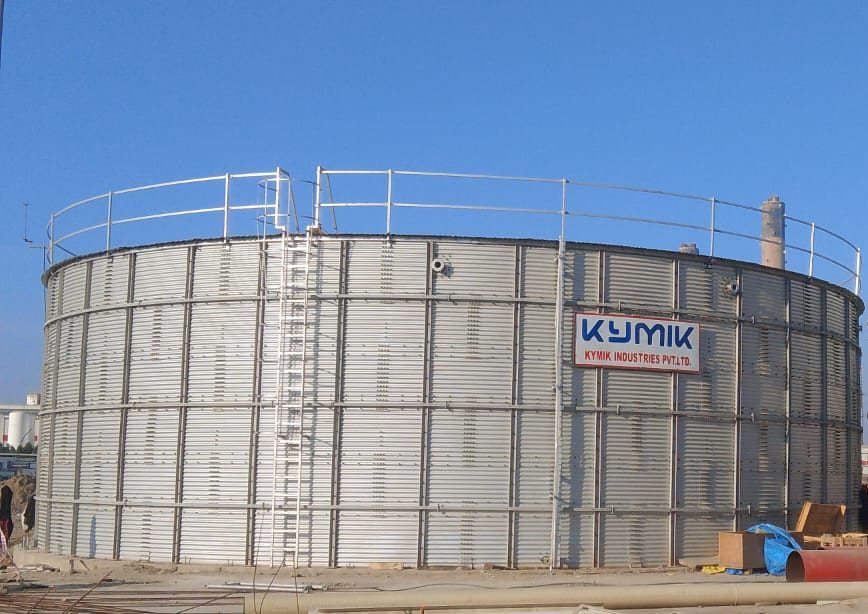
Modular bolted tanks can offer practical advantages for large projects. Manufacturers can produce individual panels at the factory and transport them to the site for assembly.
Which Materials Can You Use for Fire Water Tanks?
Different projects use different tank materials. The choice depends on capacity, site conditions, water quality, design requirements, installation conditions, and project budget.
Common options include:
- Zincalume steel tanks
- Glass-Fused-to-Steel tanks
- Coated steel tanks
- RCC tanks
- Other engineered storage systems
Zincalume tanks combine a steel structure with an aluminum-zinc coating that helps protect the surface from corrosion.
GFS tanks use a glass coating fused to steel at high temperatures. This technology provides a durable, smooth, and corrosion-resistant internal and external surface.
RCC tanks can provide a permanent storage structure, although they often involve significant civil construction.
Therefore, project teams should compare the full lifecycle of each option rather than focusing only on the initial purchase cost.
Why Choose Zincalume Fire Water Tanks?
Zincalume fire water tanks offer several advantages for industrial and infrastructure projects.
The aluminum-zinc coating helps protect the steel from corrosion and environmental exposure. At the same time, the steel structure provides the required mechanical strength for tank construction.
The modular bolted design can also simplify transportation and installation. Manufacturers can produce panels in controlled factory conditions and then transport them to the project site.
This approach becomes especially useful when a project has restricted road access or requires a large storage capacity at a remote location.
Furthermore, modular construction can support future expansion when the original design and site conditions allow it.
For industrial projects, this combination of corrosion protection, structural strength, modular construction, and installation flexibility makes Zincalume a useful tank option.
Fire Fighting Water Storage Tanks for Industrial Applications
Industrial facilities often face higher fire risks because they may store chemicals, fuels, raw materials, machinery, packaging materials, or other combustible products.
For this reason, industrial fire protection systems often require dedicated water storage.
Fire Fighting Water Storage Tanks can support applications such as:
- Manufacturing plants
- Chemical industries
- Pharmaceutical facilities
- Warehouses
- Power plants
- Oil and gas facilities
- Infrastructure projects
- Data centres
- Commercial complexes
- Logistics facilities
- Water treatment plants
Each facility has different fire risks. Therefore, designers should assess the site’s processes, materials, building layout, fire hazards, and protection systems before finalizing the tank configuration.
Fire Water Tanks for Hydrant and Sprinkler Systems
Hydrant and sprinkler systems use stored water to control or suppress fires.
A hydrant system provides water through designated outlets that trained personnel can use during firefighting. Sprinkler systems, on the other hand, release water automatically when their operating conditions trigger individual sprinkler heads.
Both systems can require a dependable water reserve.
As a result, designers must consider the combined demand when a project uses multiple firefighting systems. The tank outlet, pump suction, piping, and storage volume should all support the required system design.
Kymik supplies fire water storage solutions for applications that require dedicated emergency water storage.
Installation of Fire Fighting Water Storage Tanks
Installation quality plays an important role in the performance of any storage tank.
For a modular bolted tank, manufacturers produce the panels and components before sending them to the project site. Installation teams then prepare the foundation, position the panels, connect the sections, install the roof and fittings, and complete the required checks.
The installation process generally includes:
- Site inspection and preparation
- Foundation verification
- Material inspection
- Panel positioning
- Panel bolting
- Roof installation
- Nozzle and fitting installation
- Internal liner installation, where required
- Inspection and testing
- Final commissioning
The exact sequence depends on the tank design and project requirements.
Watch our step-by-step installation video to see our team assemble, bolt, and install Fire Fighting Water Storage Tanks at the project site.
Maintenance of Fire Water Storage Tanks
Regular inspection helps keep a fire water storage system ready for an emergency.
Facility teams should follow the inspection and maintenance schedule recommended by the tank manufacturer and the applicable fire protection requirements.
Routine checks may include:
- Tank shell condition
- Roof condition
- Bolted connections
- Water level
- Valves and fittings
- Fire pump connections
- Internal liner condition, where applicable
- Leakage
- Corrosion
- Foundation condition
- Access ladders and platforms
Operators should record inspection findings and address problems promptly.
Moreover, maintenance teams should keep the area around the tank clear. Easy access allows inspection teams to identify problems and carry out maintenance without unnecessary delays.
Fire Water Tank Standards and Compliance
Fire protection systems must follow the standards and regulations that apply to the specific project, location, building type, and protection system.
For projects that follow NFPA requirements, NFPA 22 provides requirements related to water tanks for private fire protection.
However, designers should not select a tank based on one standard alone. They should review all applicable local regulations, fire protection requirements, structural requirements, and project specifications.
For example, the tank design may need to account for wind and seismic conditions in addition to fire water storage requirements.
Therefore, project teams should involve qualified fire protection and structural professionals during the design stage.
How to Choose the Right Fire Fighting Water Storage Tanks
Choosing the right tank starts with understanding the project requirements.
Consider these key factors:
1. Required Storage Capacity- Determine the required fire water volume from the approved fire protection design.
2. Type of Fire Protection System- Identify whether the facility uses hydrants, sprinklers, monitors, deluge systems, or a combination of systems.
3. Site Conditions- Review soil conditions, available space, access roads, wind loads, seismic conditions, and environmental exposure.
4. Tank Material- Compare Zincalume, GFS, RCC, and other suitable tank options according to the project’s technical requirements.
5. Installation Requirements- Consider transportation, crane access, site restrictions, installation time, and available labour.
6. Water Quality- Assess the stored water and select suitable internal protection or liner systems where required.
7. Maintenance Access- Ensure that the final design provides practical access for inspection, cleaning, testing, and maintenance.
8. Future Expansion- If the facility may need additional storage later, consider a modular tank design that can support future expansion where technically feasible.
Why Choose Kymik for Fire Fighting Water Storage Tanks?
Kymik provides engineered water storage solutions for industrial, commercial, infrastructure, municipal, and utility applications.
Our tank solutions focus on durable construction, corrosion protection, modular installation, and reliable water storage.
Depending on project requirements, customers can consider Zincalume or Glass-Fused-to-Steel tank technology.
Kymik’s modular tank systems can also support large-capacity storage projects where transportation and site access require a practical installation approach.
If you are planning a new fire water storage project, upgrading an existing system, or comparing tank technologies, contact Kymik to discuss the required capacity, application, site conditions, and tank configuration.
You can also explore our Industrial Water Storage Tanks to understand how modular tank systems support large-scale industrial and infrastructure applications.
Conclusion
Fire Fighting Water Storage Tanks provide a dedicated water reserve that supports critical fire protection systems during emergencies. From hydrants and sprinklers to fire pumps and monitors, the tank forms an important part of the overall fire protection network.
However, reliable performance depends on more than storage capacity. Designers must consider fire water demand, tank material, structural requirements, site conditions, fittings, installation, applicable standards, and long-term maintenance.
Zincalume and GFS tanks provide durable options for projects that need corrosion-resistant and reliable water storage. Meanwhile, modular bolted construction can simplify transportation and installation, especially for large-capacity projects.
Ultimately, the right fire water tank should match the facility’s specific fire protection requirements and operating conditions. With proper engineering, installation, inspection, and maintenance, a well-designed fire water storage system can provide dependable support when a facility needs it most.